

Reducing the dividend reinvestment program enrollment from 2 days to 8 seconds
Questrade
,
Fintech

2025
Overview
Questrade is Canada's largest independent online brokerage, managing billions in assets as an alternative to traditional banks.
I led the end-to-end design of the dividend reinvestment program automation, from research to delivery. The result eliminated operational costs and reduced processing time from 2 business days to 8 seconds.
Results
55% conversion rate in the first 3 months post-launch
8 seconds to complete enrollment — previously 2 business days
~6h/day freed from the operations team
The problem
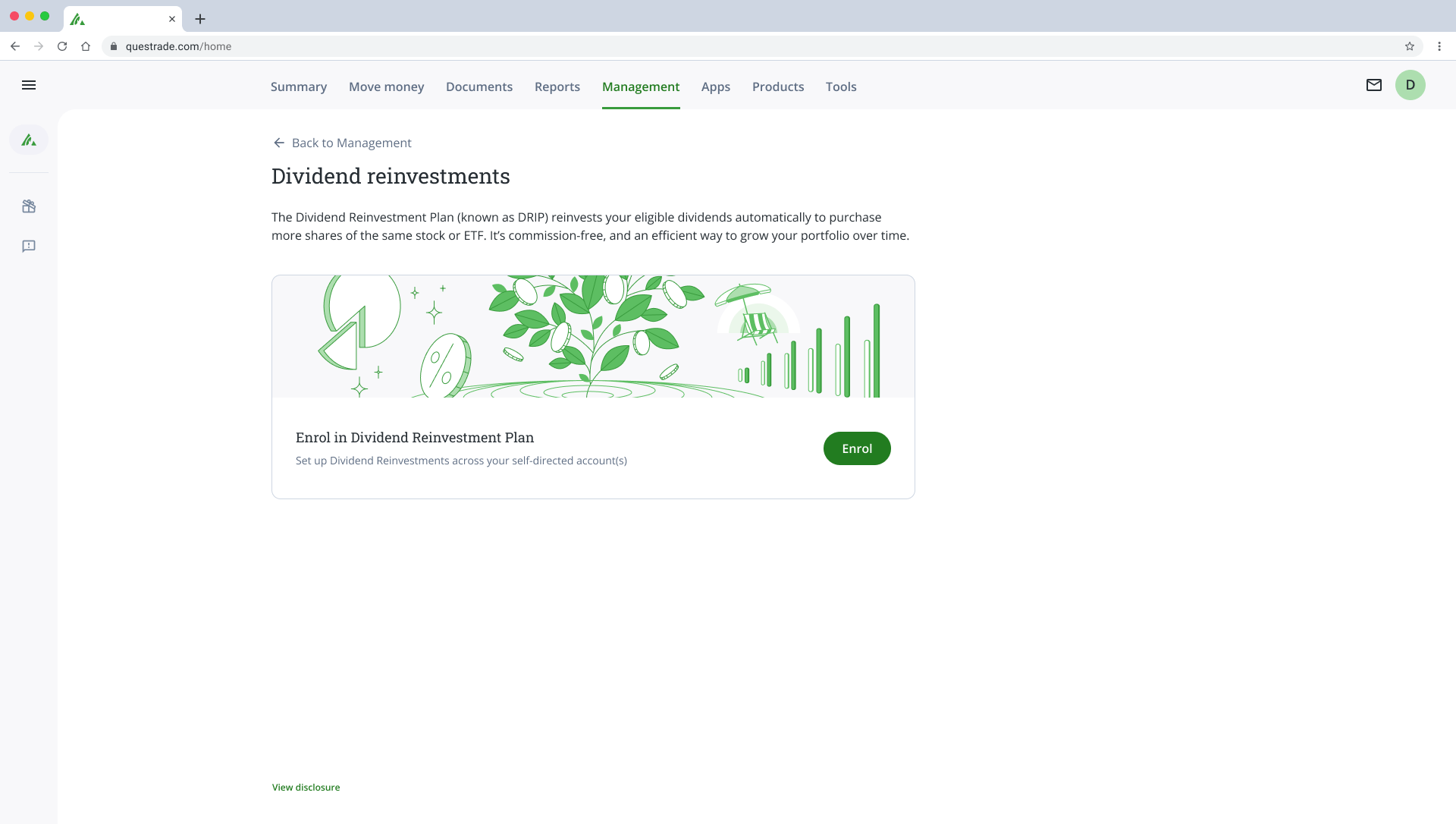
Dividend Reinvestment (DRIP) allows using received dividends to automatically buy more shares and grow a portfolio.
At Questrade, DRIP enrollment relied on a PDF form, manual approval across 3 operational teams — consuming up to 6h/day — and took 2 business days in total. Meanwhile, competitors offered the same process fully digital, in minutes.

Learnings
Understanding the pain before designing the solution
We already had the numbers: 6 to 8 hours per day spent on manual approvals, while competitors offered everything fully digital. The operational problem was clear, but we needed to understand how customers experienced it.
I went to Reddit and found users describing the experience as "archaic." Some gave up on enrolling new assets just because of the effort involved. These accounts became research hypotheses. I recruited 20 users who invested through Questrade and competitors to hear from people who had lived the difference between manual and digital.
The findings changed the project scope — instead of simply digitizing the form, there was a chance to create something that didn't exist: transparency in the process, status visibility, and continuous management within the platform.

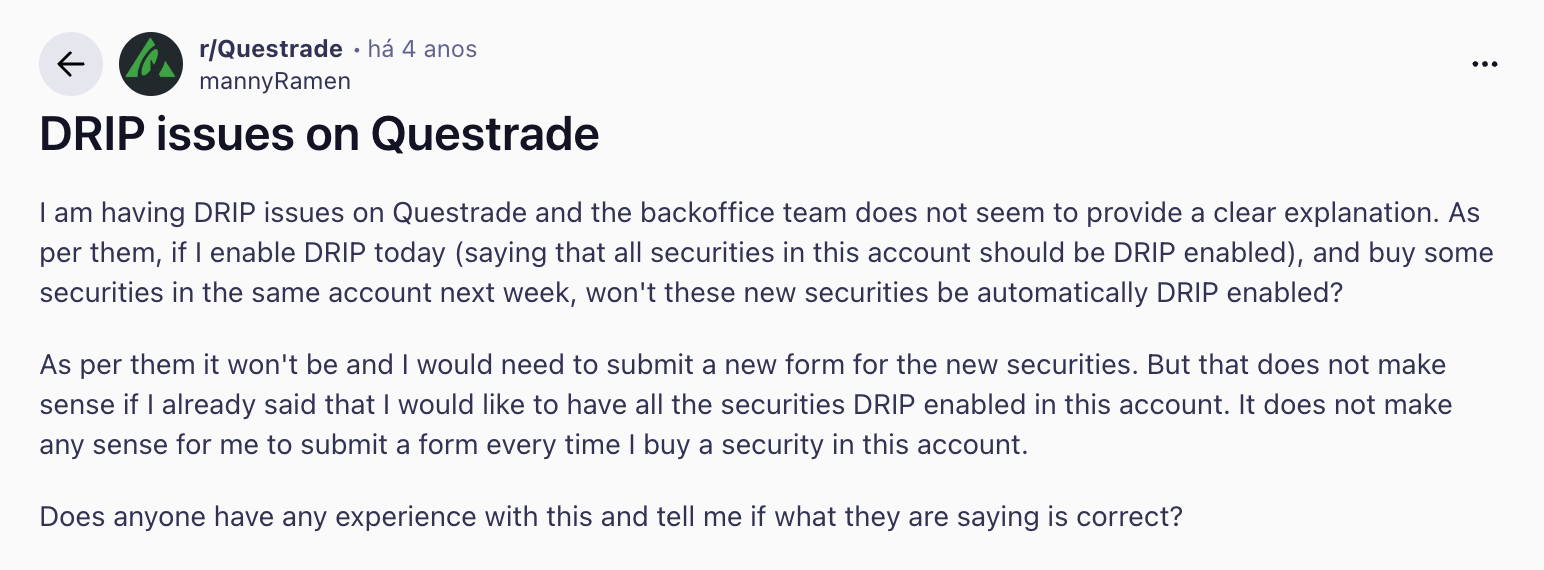

User comments on Reddit.

Behind the 2-day wait was an entire operation
I mapped the operation behind the wait time and found 11 steps across 3 operational teams. The bottleneck wasn't the analysis itself — it was the request queue and the manual rework with spreadsheets.
With that clear, the decision with engineering was: instead of designing on top of the legacy system, the new API requirements should stem from the experience we wanted to deliver. The concept required users to view and manage their enrollment at any time, which demanded something that didn't exist: a single source of truth per asset, per user.
This requirement is what unlocked continuous management and automatic enrollment of new assets.
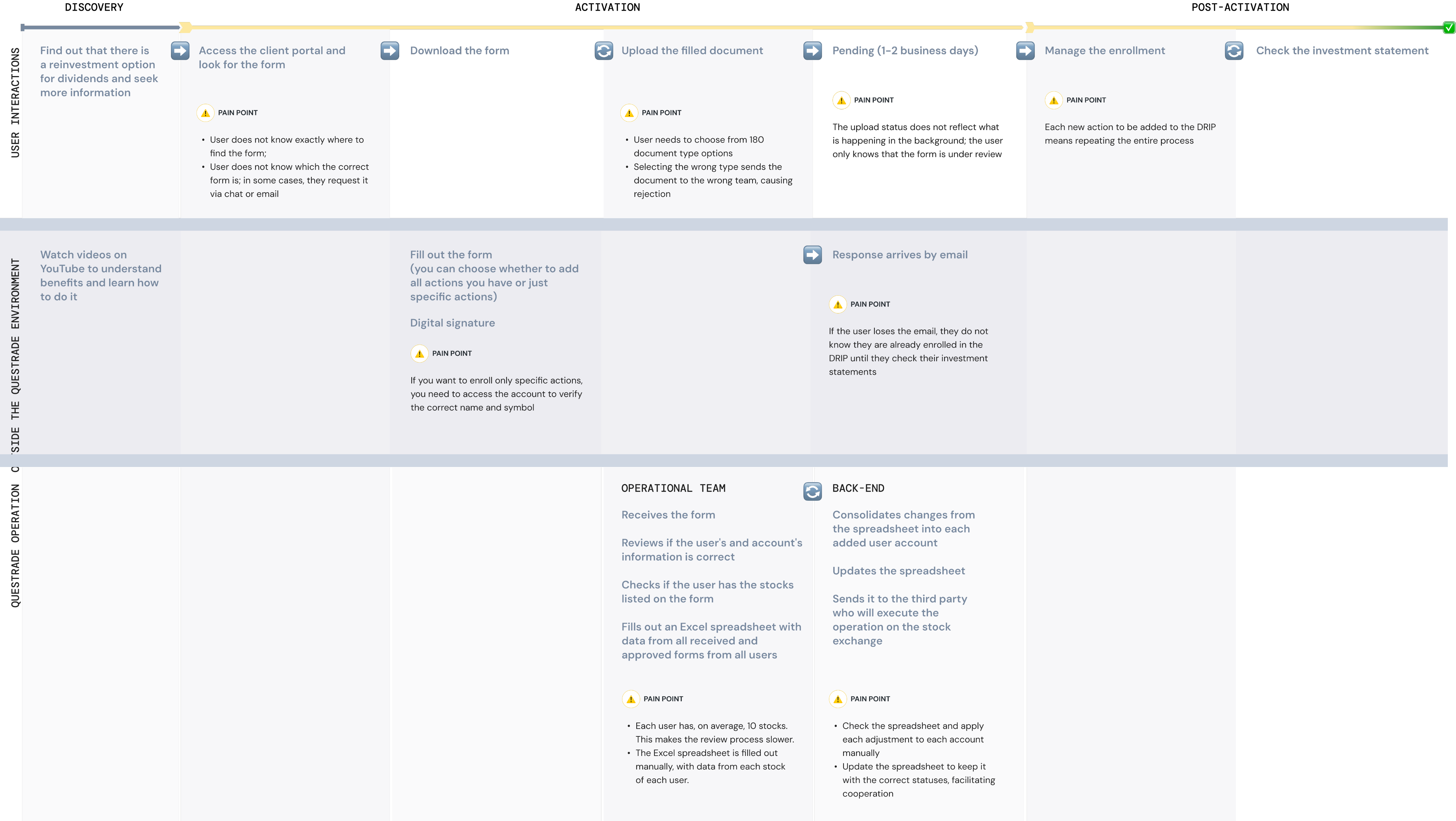
Mapping the main pain points throughout the process.
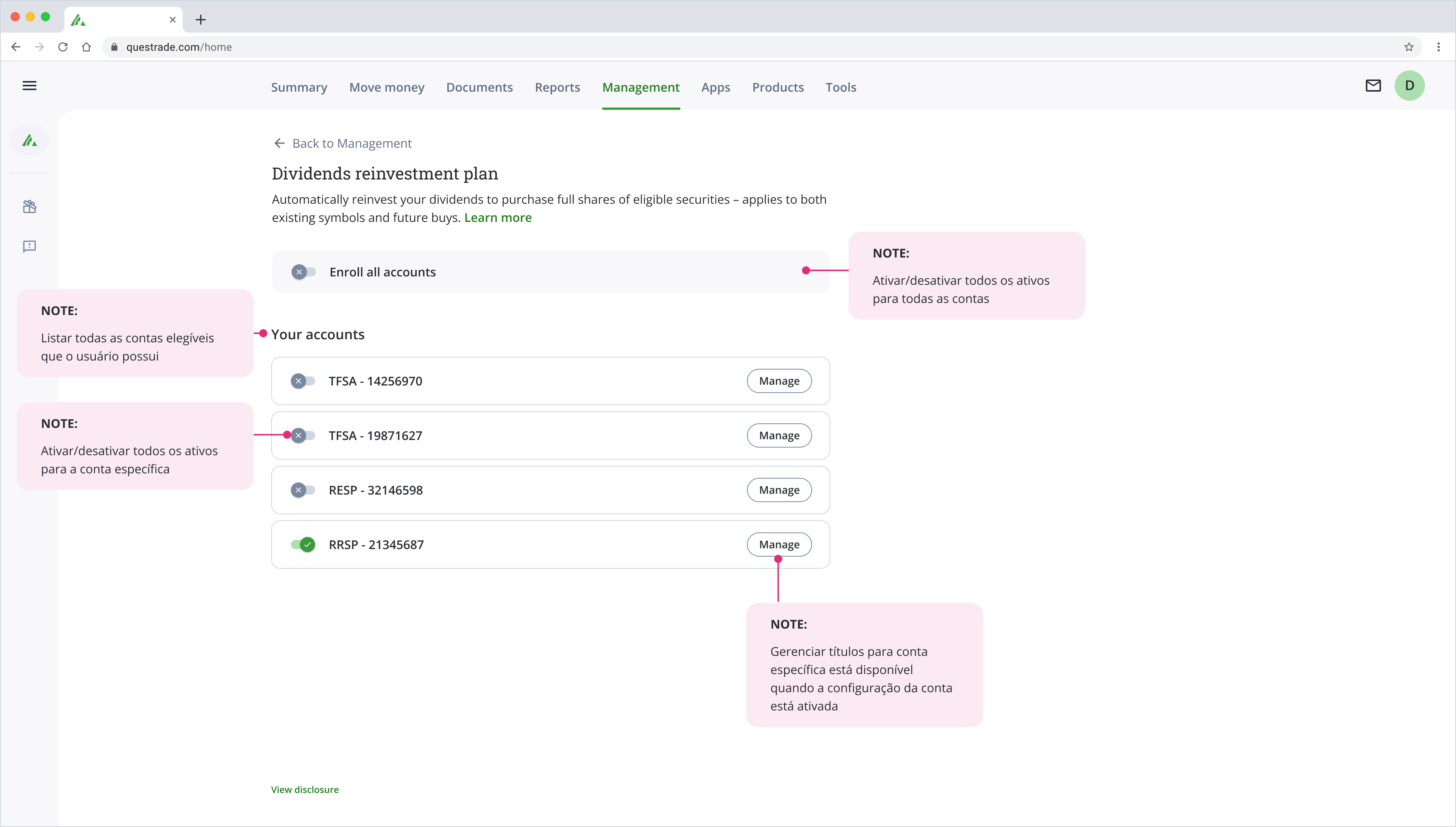
Initial concept that guided the API development.
The system limitation became the path forward
Research revealed an opportunity that RBC, Wealthsimple, and Robinhood didn't cover: individual control per asset. But the system required the initial enrollment to cover all assets in the account — a technical limitation.
Before treating this as a blocker, I looked at the data. 84% of the user base already enrolled everything, so what seemed like a limitation was, in practice, the default for most. The question became: how to serve those who wanted to customize?
The solution was to rethink the step sequence. The user accepts the terms for the entire account and then can deselect the assets they don't want to keep.
This flow brought together all the improvements identified, including the customization, the continuous management enabled by the new API, and a default aligned with real user behavior. A process that previously took 2 days and involved 3 teams now takes 8 seconds, fully managed by the user.
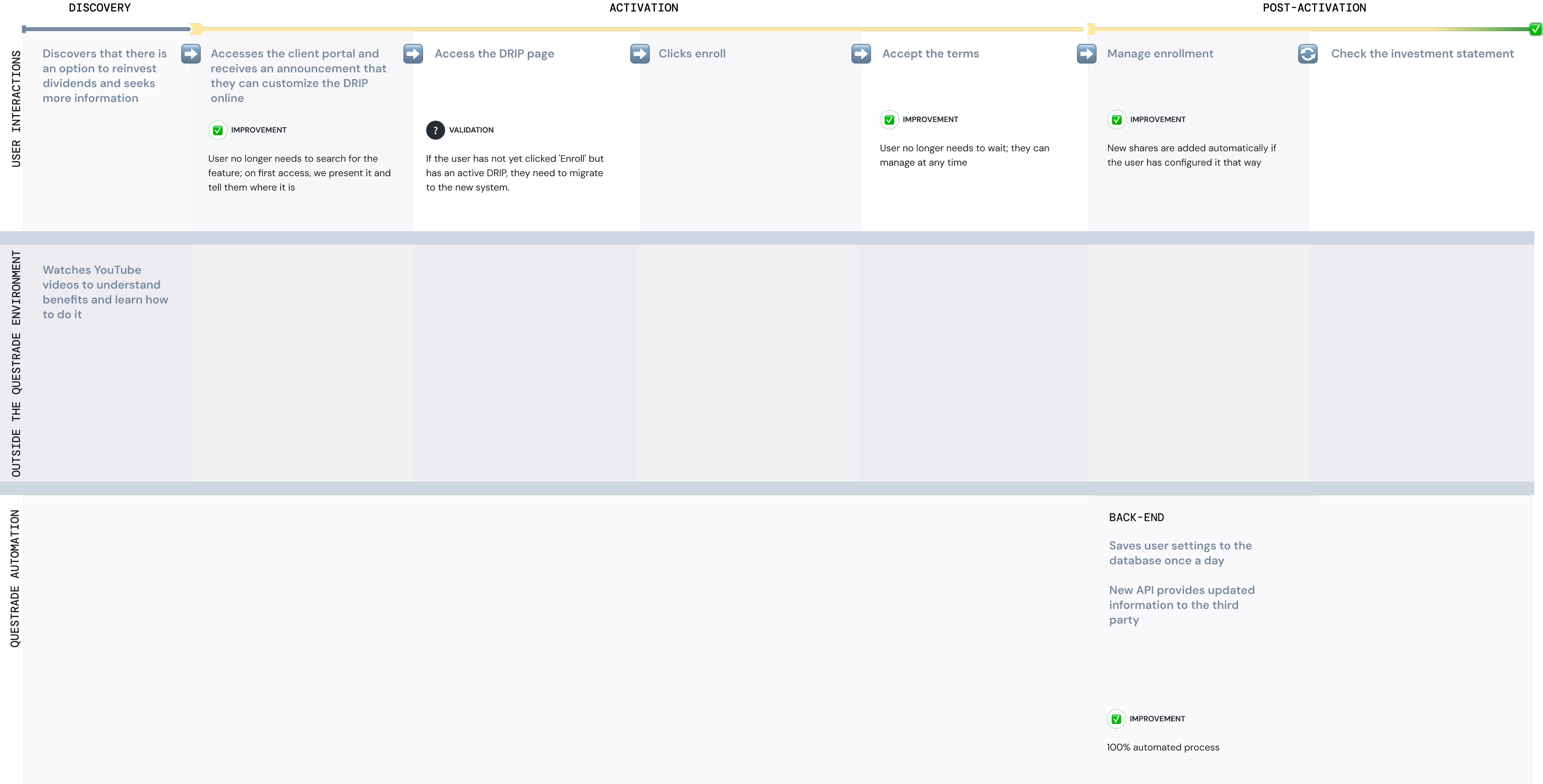
Customer journey after the enrollment flow automation.
Complete enrollment flow after digitization.
Impact
From 2 business days to 8 seconds — self-service enrollment, no team involvement.
55% conversion in 3 months — a feature previously avoided due to manual process effort.
~6h/day freed from operations with the elimination of manual approval.
More projects
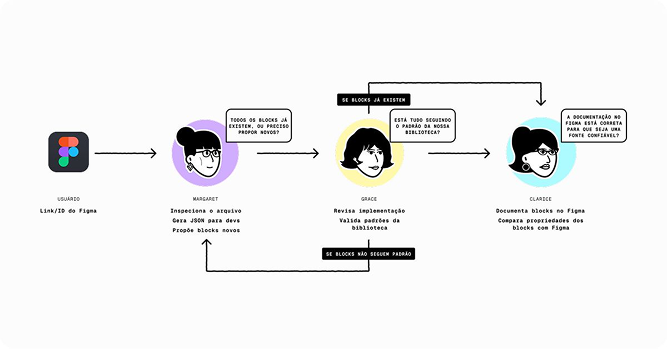
Applying AI to reduce an operational process from 36 to 1 hour of work
Bemobi Wave
,
Telecom e Utilities
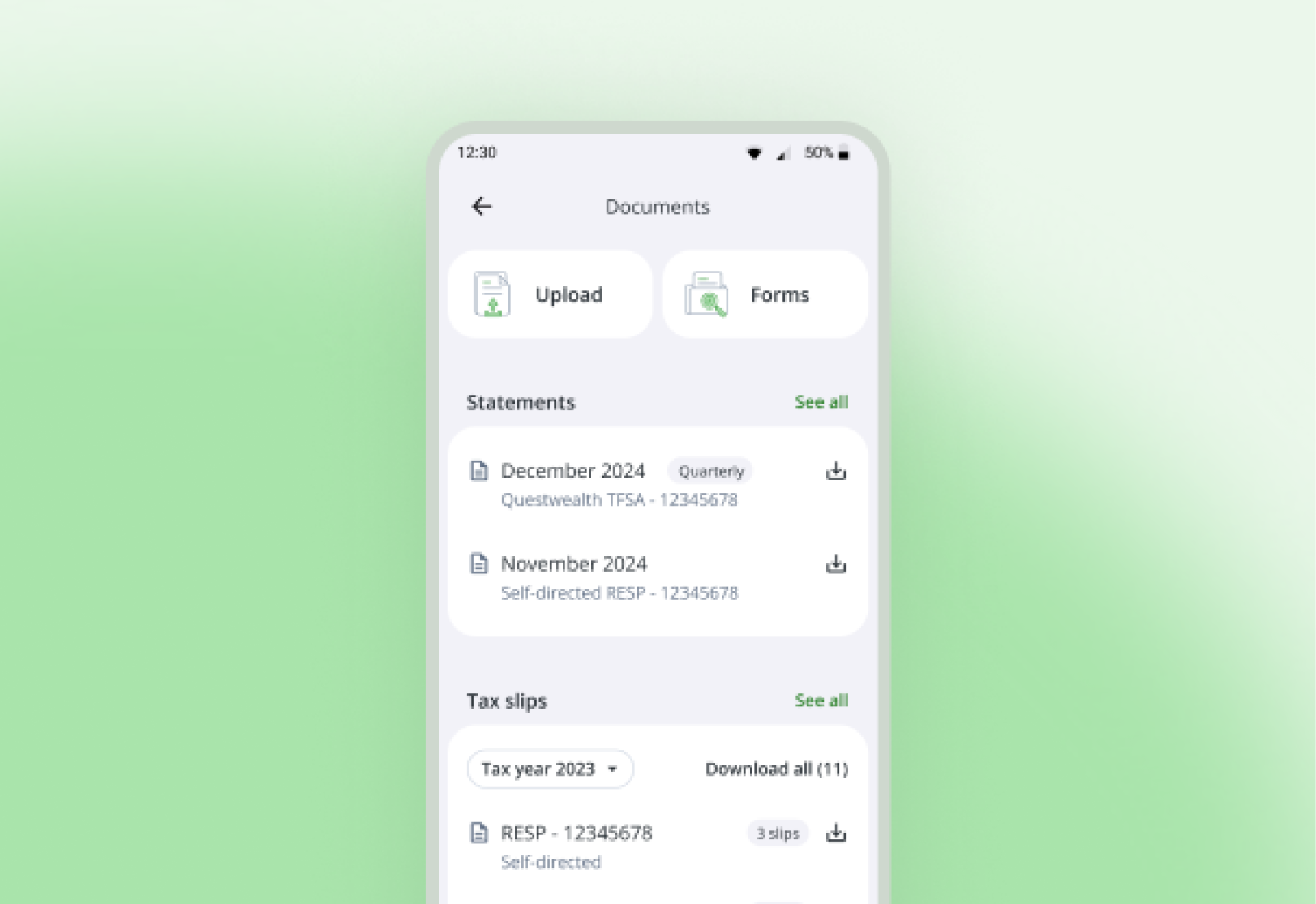
Designing the on-the-go experience for the documents tab in time for tax season
Questrade
,
Fintech
Soon
Turning terabytes of geospatial data into accessible dashboards for 1 million users
MapBiomas
,
Geotech




© Cajá ・ Senior Product Designer ・ 2026

Reducing the dividend reinvestment program enrollment from 2 days to 8 seconds
Questrade
,
Fintech
2025
Overview
Questrade is Canada's largest independent online brokerage, managing billions in assets as an alternative to traditional banks.
I led the end-to-end design of the dividend reinvestment program automation, from research to delivery. The result eliminated operational costs and reduced processing time from 2 business days to 8 seconds.
Results
55% conversion rate in the first 3 months post-launch
8 seconds to complete enrollment — previously 2 business days
~6h/day freed from the operations team
The problem
Dividend Reinvestment (DRIP) allows using received dividends to automatically buy more shares and grow a portfolio.
At Questrade, DRIP enrollment relied on a PDF form, manual approval across 3 operational teams — consuming up to 6h/day — and took 2 business days in total. Meanwhile, competitors offered the same process fully digital, in minutes.

Learnings
Understanding the pain before designing the solution
We already had the numbers: 6 to 8 hours per day spent on manual approvals, while competitors offered everything fully digital. The operational problem was clear, but we needed to understand how customers experienced it.
I went to Reddit and found users describing the experience as "archaic." Some gave up on enrolling new assets just because of the effort involved. These accounts became research hypotheses. I recruited 20 users who invested through Questrade and competitors to hear from people who had lived the difference between manual and digital.
The findings changed the project scope — instead of simply digitizing the form, there was a chance to create something that didn't exist: transparency in the process, status visibility, and continuous management within the platform.
User comments on Reddit.

Behind the 2-day wait was an entire operation
I mapped the operation behind the wait time and found 11 steps across 3 operational teams. The bottleneck wasn't the analysis itself — it was the request queue and the manual rework with spreadsheets.
With that clear, the decision with engineering was: instead of designing on top of the legacy system, the new API requirements should stem from the experience we wanted to deliver. The concept required users to view and manage their enrollment at any time, which demanded something that didn't exist: a single source of truth per asset, per user.
This requirement is what unlocked continuous management and automatic enrollment of new assets.
Mapping the main pain points throughout the process.
Initial concept that guided the API development.
The system limitation became the path forward
Research revealed an opportunity that RBC, Wealthsimple, and Robinhood didn't cover: individual control per asset. But the system required the initial enrollment to cover all assets in the account — a technical limitation.
Before treating this as a blocker, I looked at the data. 84% of the user base already enrolled everything, so what seemed like a limitation was, in practice, the default for most. The question became: how to serve those who wanted to customize?
The solution was to rethink the step sequence. The user accepts the terms for the entire account and then can deselect the assets they don't want to keep.
This flow brought together all the improvements identified, including the customization, the continuous management enabled by the new API, and a default aligned with real user behavior. A process that previously took 2 days and involved 3 teams now takes 8 seconds, fully managed by the user.
Customer journey after the enrollment flow automation.
Complete enrollment flow after digitization.
Impact
From 2 business days to 8 seconds — self-service enrollment, no team involvement.
55% conversion in 3 months — a feature previously avoided due to manual process effort.
~6h/day freed from operations with the elimination of manual approval.
More projects
Designing the on-the-go experience for the documents tab in time for tax season
Questrade
,
Fintech
Soon
Turning terabytes of geospatial data into accessible dashboards for 1 million users
MapBiomas
,
Geotech

© Cajá ・ Senior Product Designer ・ 2026
Reducing the dividend reinvestment program enrollment from 2 days to 8 seconds
Questrade
,
Fintech
2025
Overview
Questrade is Canada's largest independent online brokerage, managing billions in assets as an alternative to traditional banks.
I led the end-to-end design of the dividend reinvestment program automation, from research to delivery. The result eliminated operational costs and reduced processing time from 2 business days to 8 seconds.
Results
55% conversion rate in the first 3 months post-launch
8 seconds to complete enrollment — previously 2 business days
~6h/day freed from the operations team
The problem
Dividend Reinvestment (DRIP) allows using received dividends to automatically buy more shares and grow a portfolio.
At Questrade, DRIP enrollment relied on a PDF form, manual approval across 3 operational teams — consuming up to 6h/day — and took 2 business days in total. Meanwhile, competitors offered the same process fully digital, in minutes.

Learnings
Understanding the pain before designing the solution
We already had the numbers: 6 to 8 hours per day spent on manual approvals, while competitors offered everything fully digital. The operational problem was clear, but we needed to understand how customers experienced it.
I went to Reddit and found users describing the experience as "archaic." Some gave up on enrolling new assets just because of the effort involved. These accounts became research hypotheses. I recruited 20 users who invested through Questrade and competitors to hear from people who had lived the difference between manual and digital.
The findings changed the project scope — instead of simply digitizing the form, there was a chance to create something that didn't exist: transparency in the process, status visibility, and continuous management within the platform.
User comments on Reddit.

Behind the 2-day wait was an entire operation
I mapped the operation behind the wait time and found 11 steps across 3 operational teams. The bottleneck wasn't the analysis itself — it was the request queue and the manual rework with spreadsheets.
With that clear, the decision with engineering was: instead of designing on top of the legacy system, the new API requirements should stem from the experience we wanted to deliver. The concept required users to view and manage their enrollment at any time, which demanded something that didn't exist: a single source of truth per asset, per user.
This requirement is what unlocked continuous management and automatic enrollment of new assets.
Mapping the main pain points throughout the process.
Initial concept that guided the API development.
The system limitation became the path forward
Research revealed an opportunity that RBC, Wealthsimple, and Robinhood didn't cover: individual control per asset. But the system required the initial enrollment to cover all assets in the account — a technical limitation.
Before treating this as a blocker, I looked at the data. 84% of the user base already enrolled everything, so what seemed like a limitation was, in practice, the default for most. The question became: how to serve those who wanted to customize?
The solution was to rethink the step sequence. The user accepts the terms for the entire account and then can deselect the assets they don't want to keep.
This flow brought together all the improvements identified, including the customization, the continuous management enabled by the new API, and a default aligned with real user behavior. A process that previously took 2 days and involved 3 teams now takes 8 seconds, fully managed by the user.
Customer journey after the enrollment flow automation.
Complete enrollment flow after digitization.
Impact
From 2 business days to 8 seconds — self-service enrollment, no team involvement.
55% conversion in 3 months — a feature previously avoided due to manual process effort.
~6h/day freed from operations with the elimination of manual approval.
More projects
Applying AI to reduce an operational process from 36 to 1 hour of work
Bemobi Wave
,
Telecom e Utilities
Designing the on-the-go experience for the documents tab in time for tax season
Questrade
,
Fintech
Soon
Turning terabytes of geospatial data into accessible dashboards for 1 million users
MapBiomas
,
Geotech
© Cajá ・ Senior Product Designer ・ 2026