Automating a two-day operational process into an autonomous experience completed in seconds
Questrade is Canada's largest independent online brokerage, managing billions in assets. In this project, I led the design of the dividend reinvestment program automation, which eliminated the operations team's manual work and reduced processing time from 2 business days to 8 seconds.
My role
Product Designer
Scope
End-to-end, from discovery to delivery
Team
Product Managers and developers
The problem
The Dividend Reinvestment Program (DRIP) allows clients to use received dividends to automatically purchase more shares. At Questrade, enrolling a client in DRIP involved a PDF, manual approval from 3 operational teams, and a 2 business day wait, consuming about 6 hours per day of operations. Meanwhile, competitors like Wealthsimple and Robinhood already offered the same process 100% digitally, completed in minutes.
The solution
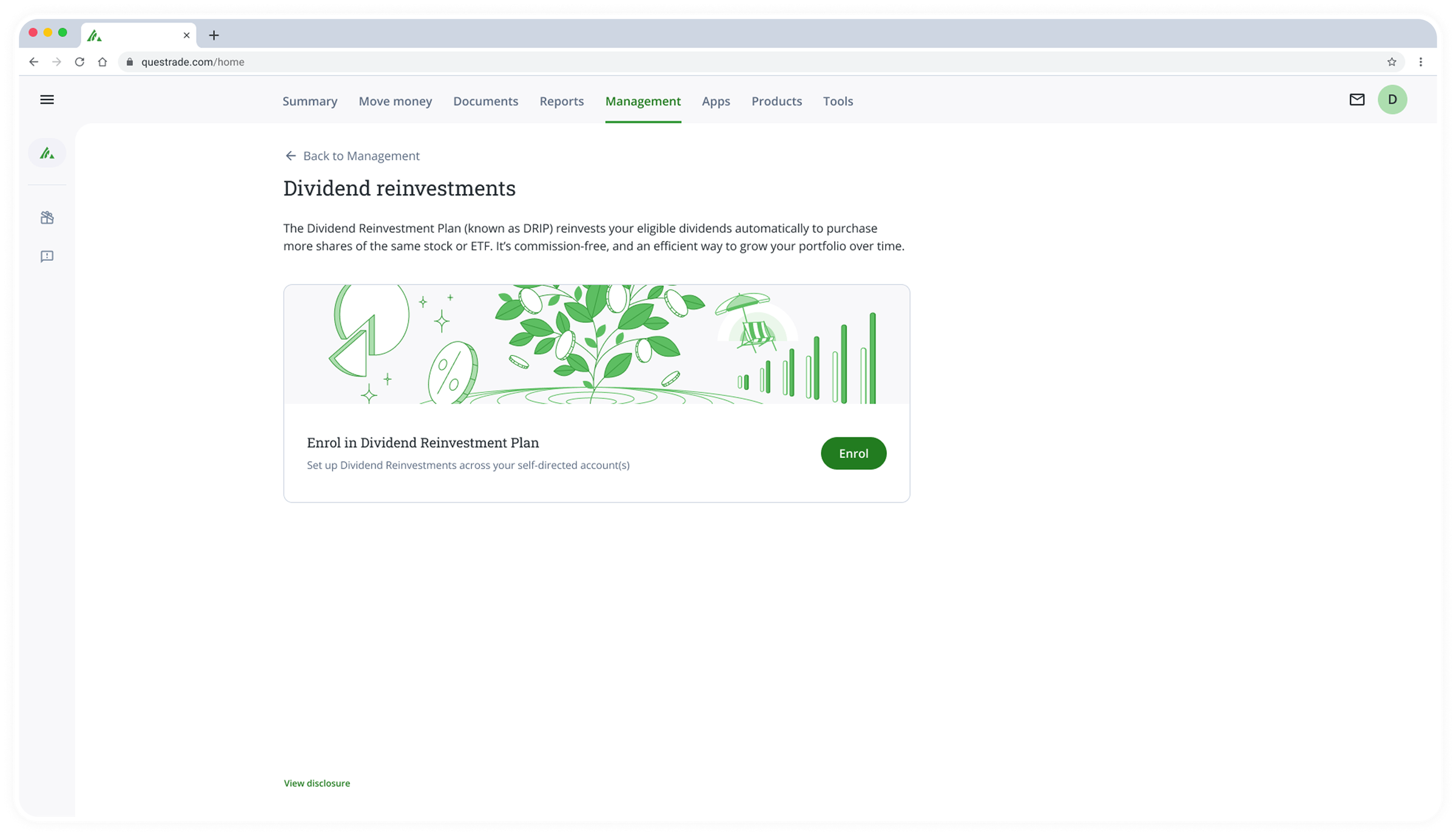
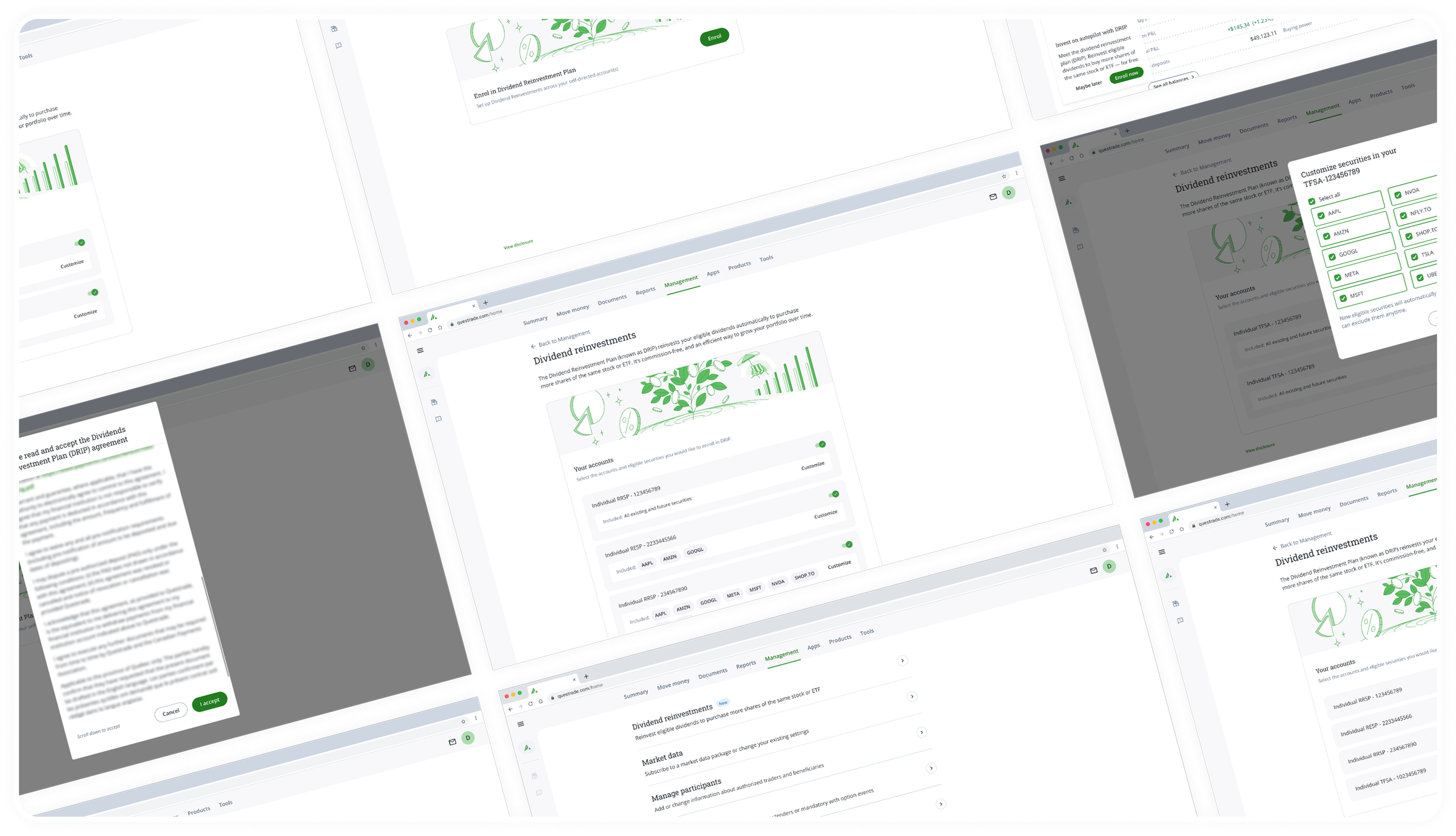
I redesigned enrollment as a self-service flow the client completes in seconds, without PDF forms or manual approval. Beyond solving the operational bottleneck, the new experience lets users view, manage, and change their enrollment at any time, something no direct competitor offered at the time.
The impact
In the first 3 months after launch, 55% of eligible clients enrolled in the program. Enrollment, which previously took 2 business days, was now completed in 8 seconds, and the operations team recovered about 6 hours per day previously spent on manual approvals.
Three key insights
01. From operational bottleneck to competitive advantage, the research that redefined the project scope 02. The ideal experience as the starting point for the new API 03. A technical limitation can work in favor of the experience when approached strategically
Insight 01
From operational bottleneck to competitive advantage, the research that redefined the project scope
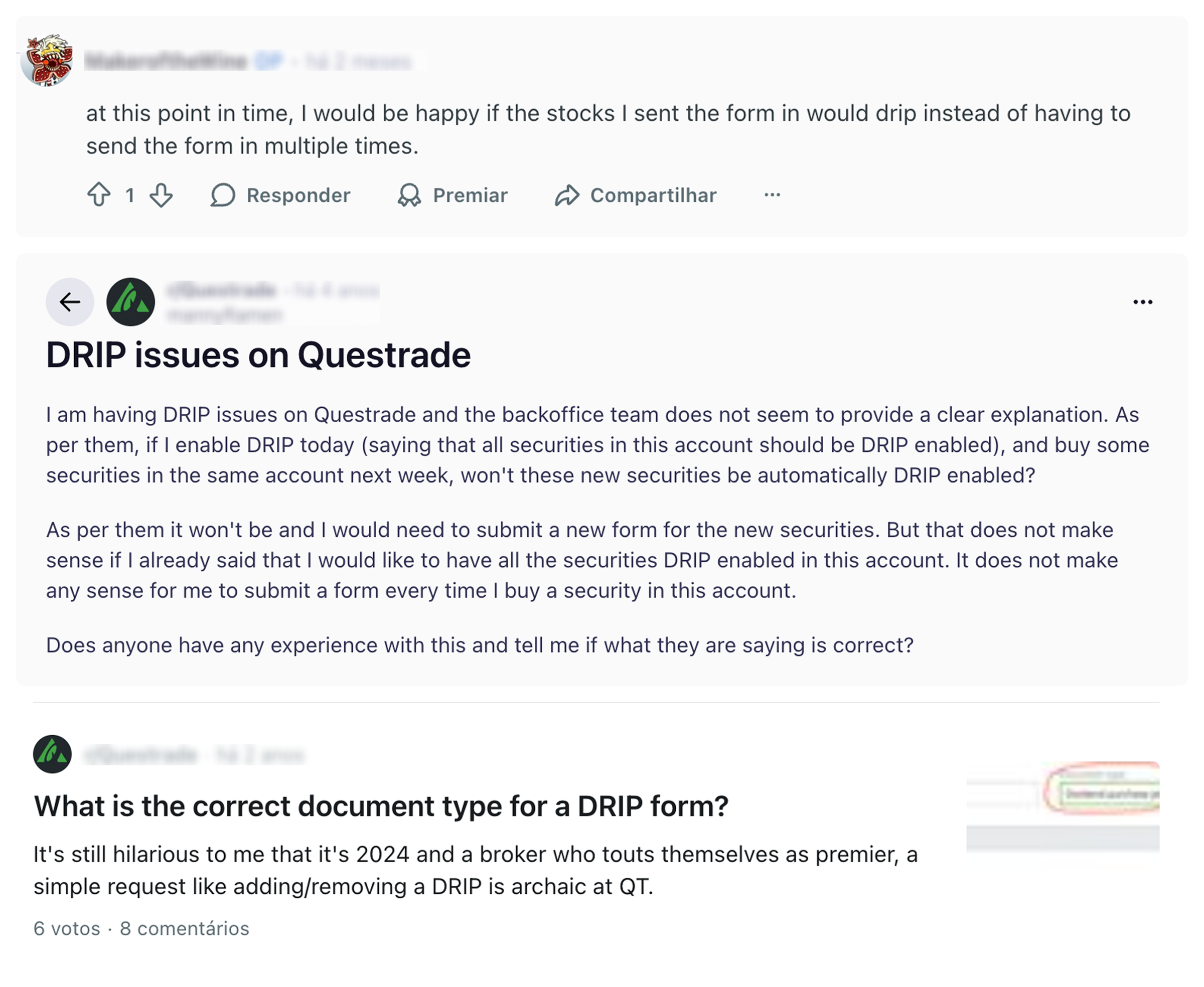
An internal mapping revealed the bottleneck that became our starting point: about 6 hours per day were dedicated by the operations team to manually processing DRIP enrollments. It wasn't clear yet, however, how the client perceived this process. On Reddit, I found comments describing the experience as "archaic", and some clients reported giving up on enrolling new assets just because of the effort involved. This initial research led me to recruit 20 users who invested through both Questrade and competitors, to hear from people who had experienced the difference between manual and digital. The findings redefined the project scope by highlighting the need to digitize the process and revealing users' interest in controlling reinvestment at a granular level, choosing which stocks to reinvest in each account they held, something no competitor offered.
Insight 02
The ideal experience as the starting point for the new API
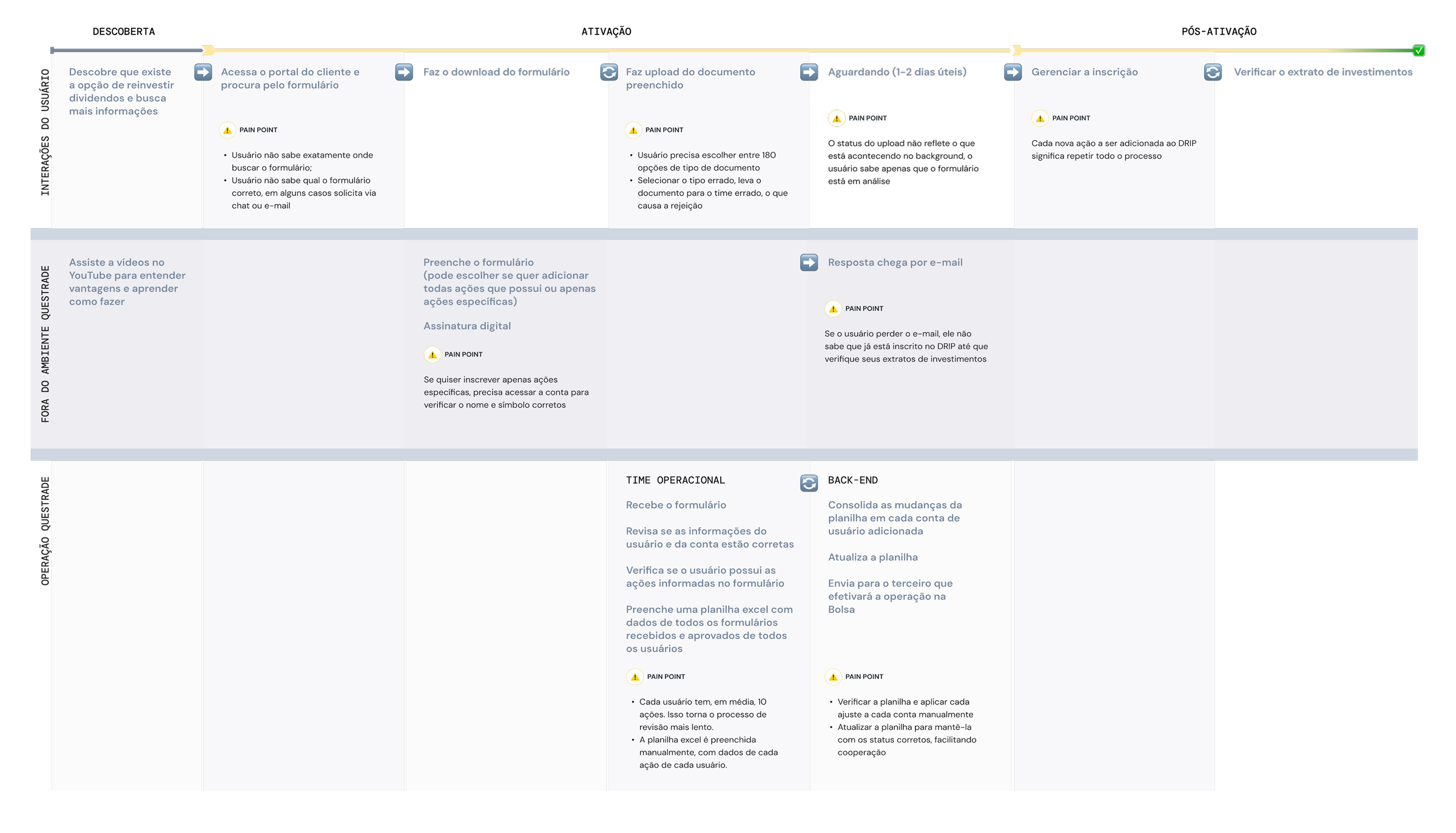
I mapped the 11 steps distributed across 3 operational teams behind the 2-day wait and discovered that the bottleneck wasn't the analysis itself, but the request queue and manual rework with spreadsheets. This discovery changed the conversation with engineering, because instead of digitizing the existing flow, we decided that the new API requirements should start from the experience we wanted to deliver. This meant giving the user visibility and ongoing control of their enrollment, which required building a single source of truth per asset and per user, something that didn't exist in the legacy system. It was this requirement that unlocked both continuous management and automatic enrollment of new assets.
Insight 03
A technical limitation can work in favor of the experience when approached strategically
The system required that DRIP enrollment cover all assets in the account at once, a strategy to enable automatic migration of users already registered in the legacy system. Initially, this seemed like a blocker for offering the individual asset control that research revealed as an opportunity. But when I looked at usage data, I found that 84% of the user base already enrolled all their assets in DRIP, meaning this requirement was, in practice, the default most users followed. From there, I redesigned the flow so that the technical limitation worked in favor of the experience, combining the granular customization users asked for, the continuous management from the new API, and a default aligned with actual behavior.
Results
- From 2 business days to 8 seconds in a self-service enrollment process, without going through any team.
- 55% conversion in 3 months for a feature that was previously avoided due to the effort of the manual process.
- ~6h/day freed from operations by eliminating manual approval.